The Jot Loop
Feedback in.
Fixes out.
Leave Claude Code running in your repo. Each new Jot from a reviewer gets picked up, planned or fixed, tested, and answered on the exact element they pointed at.
How it works
One Jot in, one reply out, then the next.
- 1
A reviewer pins it
They click the broken element on the live page and type one sentence. The Jot carries the screenshot, selector, URL, browser and, on Record, a replay.
- 2
The agent picks it up
jot watch --once returns the next new Jot. The agent marks it in progress, so nobody else takes it.
- 3
A plan, or the fix
/jot loop proposes a short plan and waits for your OK. /jot loop fix implements it straight away.
- 4
Your tests run
The agent runs the project's tests before it calls anything done, and adds one when the bug could come back.
- 5
The reporter gets the reply
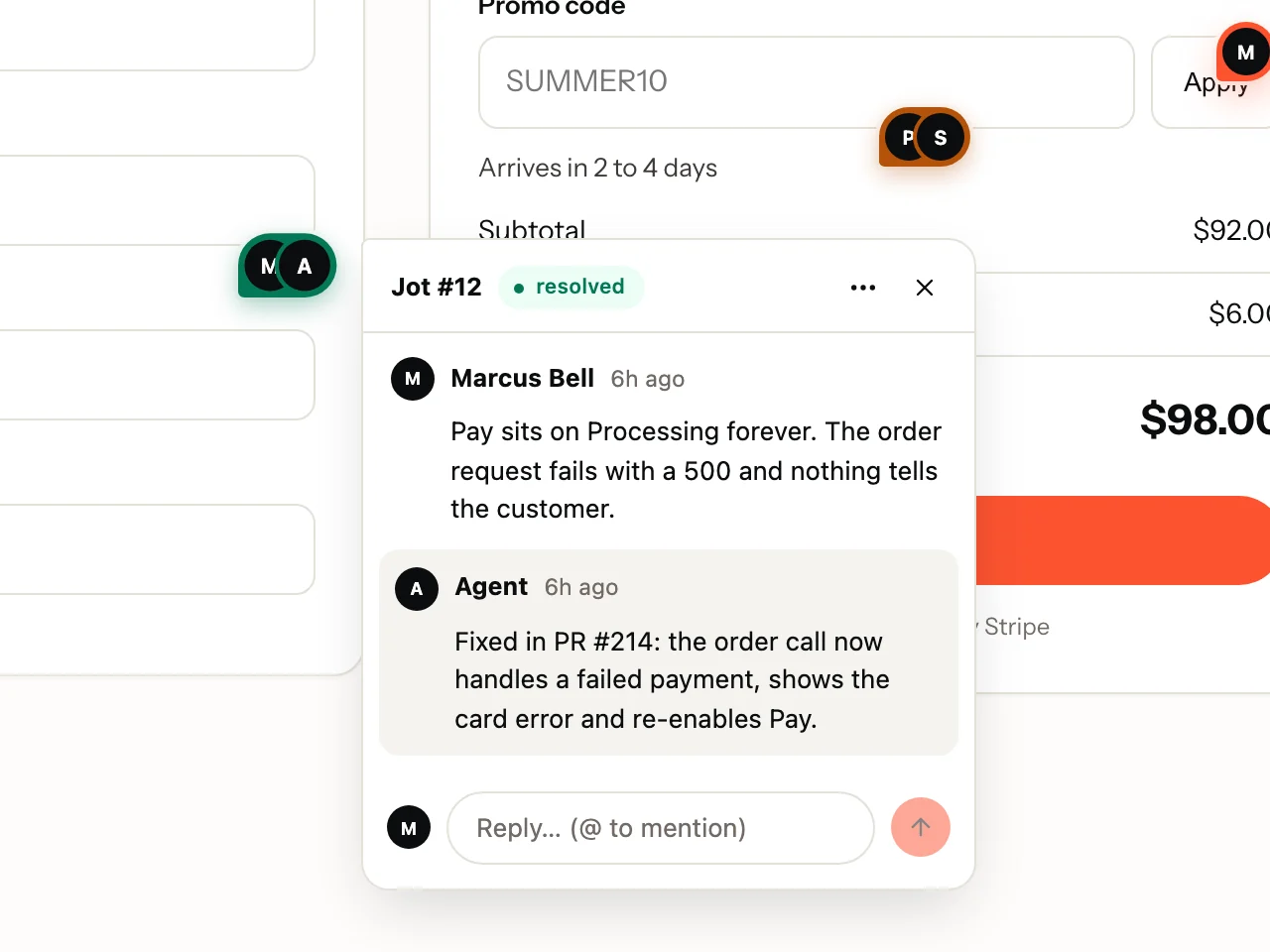
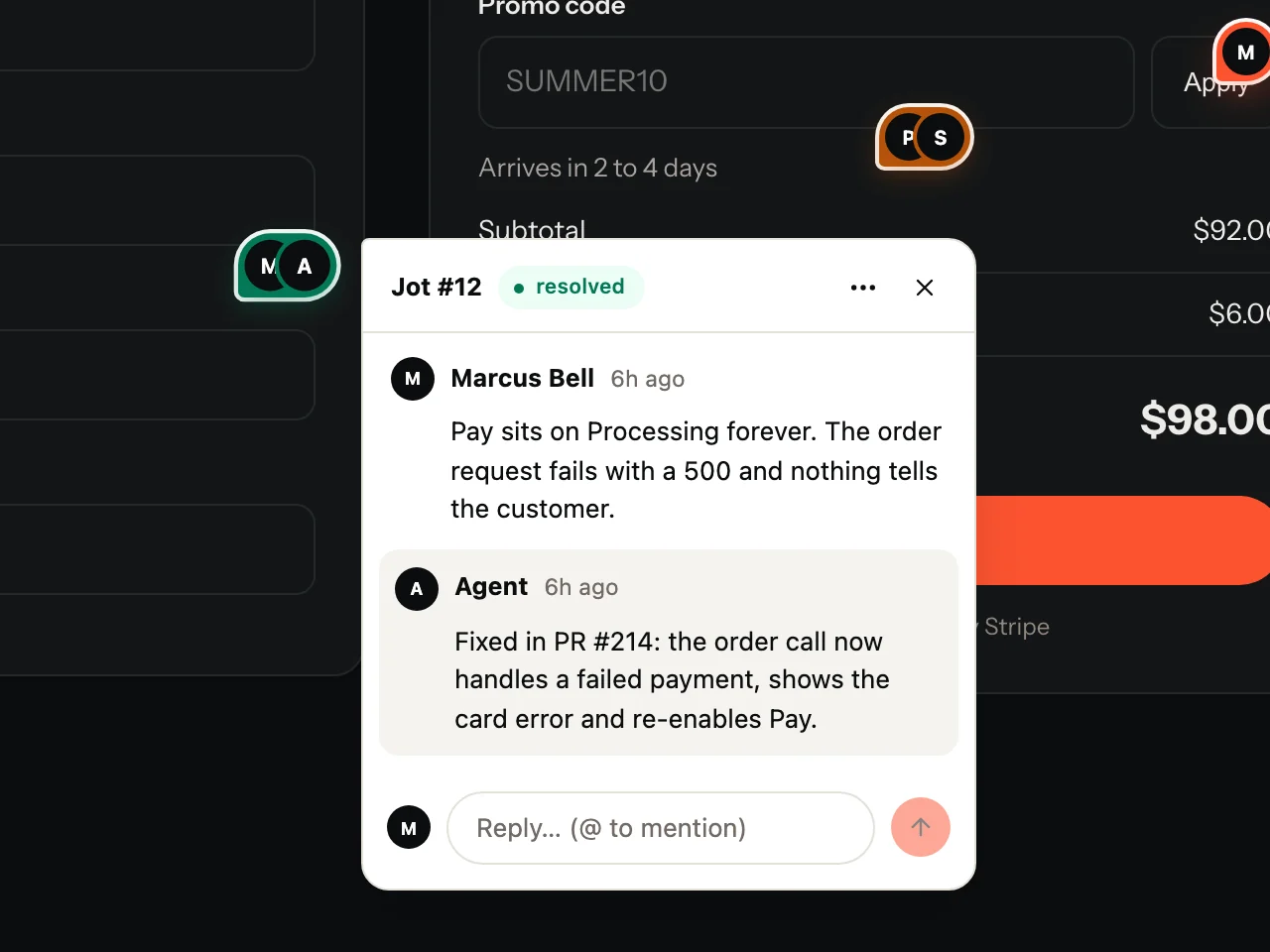
Resolved, with a reply on the reporter's pin saying what changed. They check it on the page and approve it. Then the loop waits for the next Jot.
Two modes
Approve every plan, or let it fix.
Propose
The agent works out the cause and shows you a short plan: which files, what changes, how to verify. Nothing is edited until you say OK.
/jot loop
Fix
The same loop without the stop: the agent implements the fix, runs the tests, resolves the Jot and replies. For a queue you trust it with.
/jot loop fix
What /jot loop tells Claude Code
- Run
jot watch --oncewith the Bash tool. It waits for the next new comment and prints it. - update_status IN_PROGRESS on it.
- Propose the change as a short plan and wait for the user's OK before editing anything.
- Once approved: implement, run the tests, update_status RESOLVED and post_reply with what changed.
- Go back to step 1.
Headless
No terminal open? Run it on a spare machine.
jot loop [--agent claude] [--fix] runs one Claude Code session per new Jot, on any machine with the repo, the jot CLI and Claude Code on it. In propose mode the plan is posted on the Jot as a reply, for the team to approve there.
jot loop --agent claude
What the agent is told: Do not edit any file. Work out the cause and propose the change as a short plan: which files, what changes, how to verify. Your answer is posted on the comment as a reply for the team to approve.
jot loop --agent claude --fix
What the agent is told: Fix it in this codebase now. Run the project's tests if you are allowed to. Finish with a short summary of what you changed (files, and why): that summary is posted to the reporter as a reply.
You stay in charge
Resolved means please check.
- Agents reply and resolve; who approves is your workspace's choice (by default, the person who reported it).
- The agent resolves and replies; the reporter checks the fix on the page and approves it, or says it is still wrong.
Set up
Two lines, then type /jot loop.
Inside Claude Code, type /jot loop (propose, then wait for your OK) or /jot loop fix.
Run jot init in the repo first if /jot is not there yet. Step by step in the docs
/plugin marketplace add usejot/claude-plugins
/plugin install jot@usejot
Then ask Claude to connect Jot (it opens your browser), or paste an agent token when Claude Code asks.
npx @usejot/cli login
npx @usejot/cli init
login opens your browser to pick a workspace. init connects the repo. No token to paste.
Questions
What is the Jot Loop?
A coding agent that works your feedback queue as it arrives. Inside Claude Code, /jot loop waits for the next Jot, marks it in progress, proposes a plan and waits for your OK, then fixes it, runs your tests, resolves it and replies on the reviewer's pin. Then it waits for the next one.
Does the agent change my code without asking?
Not in propose mode. /jot loop waits for your OK before editing anything, and headless jot loop --agent claude runs Claude Code in plan mode and posts its plan on the Jot for the team to approve. /jot loop fix and --fix are the modes that edit straight away.
Can the agent approve its own fix?
Agents reply and resolve; who approves is your workspace's choice (by default, the person who reported it). Resolved means "please check", not "closed".
How does it see new feedback?
jot watch --once checks for new open Jots every 5 seconds and returns the first one. The loop runs it, works that Jot, and runs it again.
Which agents can run it?
/jot loop is Claude Code's command, and the headless loop runs claude for now. Cursor, Codex and other agents get the same steps, loop included, from jot prompt, and work Jots over MCP.
Do I need a paid plan?
No. MCP agents and the loop are on every plan, Free included. Free has 1 project and 100 Jots a month, and reviewers are free on every plan.
Also: Jot for Claude Code · The MCP server
Put your feedback queue on a loop.
Start free. Agents and the loop are on every plan, Free included.